
INS Kursura Submarine Museum, Vizag: Complete Visitor Guide
Resting on the sands of RK Beach, INS Kursura is South Asia's first submarine museum. Discover its naval history, interior compartments, visiting hours, entry fees, and travel tips.
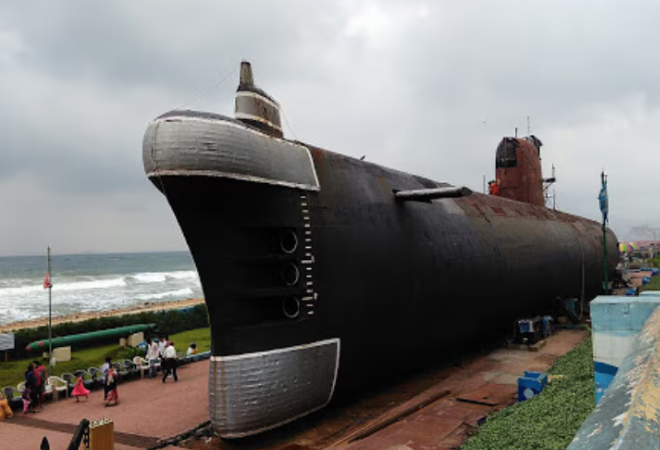
Resting directly on the golden sands of Ramakrishna Beach in Visakhapatnam, the INS Kursura Submarine Museum offers an extraordinary look inside the silent world of undersea naval warfare. The decommissioned Kalvari-class diesel-electric submarine, designated with pennant number S20, served the Indian Navy for over three decades before finding a permanent berth on shore. Established as a museum ship in August 2002, it holds the distinction of being the first submarine museum in South Asia and remains one of the very few preserved naval submarines in the world that retains nearly all of its original machinery and internal layout.
Today, guided walkthroughs led by veteran naval submariners allow visitors to step through genuine watertight hatches, examine Soviet-era propulsion gear, look through periscope assemblies, and understand the rigorous conditions endured by the submariners who lived and fought aboard.
Quick Facts
- Official Name: INS Kursura (Pennant No. S20)
- Class: Kalvari-class (Soviet Foxtrot-class / Project 641)
- Type: Patrol diesel-electric submarine
- Commissioned: 18 December 1969 (Riga, Soviet Union)
- Decommissioned: 27 February 2001
- Dedicated as Museum: 9 August 2002 [VERIFY: Public opening is cited as 14 August 2002 in some records and 24 August 2002 in others]
- Location: RK Beach Road, Pandurangapuram / Chinna Waltair, Visakhapatnam
- Managed by: Visakhapatnam Metropolitan Region Development Authority (VMRDA) with technical oversight from the Eastern Naval Command
- Hull Dimensions: Length 91.3 metres (300 ft), beam 7.5 to 8 metres, draught 6 metres
- Displacement: 1,950 tonnes surfaced; 2,475 tonnes submerged
History and Operational Legacy
Constructed in the Soviet Union at Yard 196 in Leningrad (now Saint Petersburg), INS Kursura was commissioned on 18 December 1969 at Riga under the command of Commander Arun Auditto. It was the fourth submarine inducted into the Indian Navy's burgeoning submarine arm. Beginning its maiden voyage to India on 20 February 1970, Kursura undertook a long journey around the Cape of Good Hope, touching ports in Sweden, Spain, Ghana, and Mauritius before arriving on Indian shores in April 1970.
Assigned to the Western Naval Command alongside sister vessel INS Karanj, Kursura was immediately tasked with strategic patrol responsibilities across the Arabian Sea. During the Indo-Pakistani War of 1971, Kursura was the newest and only fully operational unit among India's first batch of four Foxtrot-class submarines. Operating under strict rules of engagement, the submarine conducted extensive surveillance patrols off designated shipping lanes and monitored foreign commercial aircraft and maritime traffic, projecting naval deterrence along critical sea lines of communication.
In the decades that followed, Kursura served as an active testing platform, including trial firing the indigenous NSTL 58 torpedo in 1975. After undergoing a major refit in the Soviet Union between 1980 and 1982, the submarine resumed active patrol duties in 1985. In February 1994, alongside INS Taragiri, Kursura participated in the Indian Navy's first bilateral anti-submarine warfare exercises with the Republic of Singapore Navy off Port Blair, followed by diplomatic goodwill port calls to Singapore and Jakarta later that year.
After completing 31 years of frontline active service and logging more than 72,000 nautical miles across the oceans, INS Kursura was formally decommissioned on 27 February 2001. In an extraordinary gesture of respect, the Indian Navy continues to accord the vessel the ceremonial Dressing Ship honour during naval festivities, an accolade almost exclusively reserved for active warships in commission.
The Engineering Feat: Bringing the Submarine Ashore
The vision of converting the vessel into an educational maritime memorial is credited to Vice Admiral V. Pasricha. Transforming a 2,000-tonne combat submarine into a shoreside museum posed immense engineering challenges. The technical execution was spearheaded with assistance from the National Ship Design and Research Centre (NSDRC).
The submarine had to be carefully towed into position from the waters of the Bay of Bengal, winched across 600 metres of loose coastal sand, and securely stabilized atop concrete cradles above the high-tide line on RK Beach. The operation spanned roughly 18 months at an estimated cost of ₹5.5 crore (₹55 million). Chief Minister N. Chandrababu Naidu officially dedicated the museum to the nation on 9 August 2002.
What to See Inside the Submarine
The museum layout maintains a linear, unidirectional walkthrough from bow to stern. Life-sized mannequins in naval uniform are placed throughout the compartments to illustrate operational duties and living conditions, accompanied by period photographs, operational diagrams, and battle citations. Knowledgeable retired naval personnel are stationed inside to narrate operational details and answer questions.
1. Forward and Aft Torpedo Rooms
INS Kursura carried 10 torpedo tubes (six forward and four aft) capable of discharging 22 Type 53 torpedoes or laying up to 44 naval mines. In the forward torpedo compartment, visitors can observe the massive brass launch tubes, loading cradles, and authentic inert practice torpedoes positioned in their racks.
2. The Control Room and Periscopes
The nerve centre of the submarine features complex analog instrumentation, dive planes, pneumatic valve consoles, depth gauges, and the central periscope assembly. Visitors can see the helmsman's station, master compasses, and the mechanical levers used to control the trim and buoyancy of the boat while submerged.
3. Radar, Sonar, and Communication Cabins
Small, partition-divided cubicles showcase early surface-search radar systems (including the original Soviet 'snoop tray' radar) and sensitive acoustic sonar monitoring consoles that allowed the submarine crew to detect distant vessel cavitation underwater.
4. Battery Compartments
Operating as a conventional diesel-electric boat, Kursura relied on massive banks of lead-acid storage cells to move quietly underwater. The submarine carried 448 individual heavy battery cells spread across dedicated lower-deck compartments, providing submerged endurance of up to 10 days at low speeds.
5. Engine Room and Propulsion Machinery
The engine room houses the submarine's primary surface propulsion: three heavy-duty Kolomna 2D42M diesel engines generating 2,000 horsepower each, coupled with three electric drive motors powering three separate propeller shafts. The compartment is filled with exposed manifolds, oil lines, generator panels, and engine-order telegraphs.
6. Living Quarters, Mess, and Galley
Perhaps the most eye-opening part of the tour is observing the crew accommodation. A complement of approximately 75 crew members (8 officers and 67 sailors) lived in tight, air-restricted conditions. Visitors can inspect the miniature galley where hot meals were prepared for the entire crew, the compact officer wardroom, the commanding officer's spartan cabin, and the sailor bunks stacked tight against torpedo reload bays, illustrating the naval practice of 'hot bunking' where crew members shared sleeping berths in shifts.
Timings and Entry Fees
The submarine museum operates on fixed daily hours managed by the VMRDA. Note that ticket counters generally close 30 minutes before the gates close.
- Tuesday to Saturday: 2:00 PM – 8:30 PM
- Sunday: 10:00 AM – 12:30 PM (Morning session) and 2:00 PM – 8:30 PM (Evening session)
- Monday: Closed all day for maintenance
Standard Ticket Tariffs:
- Adults: ₹70 per person
- Children (under 12 years): ₹40 per child
- School Groups: ₹20 per student (with institutional authorization)
- Still Camera Fee: ₹50
- Video Camera Fee: ₹200
Tip: Integrated combo tickets covering the cluster of RK Beach museums (INS Kursura, the TU-142M Aircraft Museum, and the Sea Harrier Museum) are frequently available at ticket booths for a bundled rate (typically ₹140 to ₹200), offering savings for visitors planning to tour all three maritime exhibits.
How to Reach
INS Kursura is centrally located along Visakhapatnam's main coastal thoroughfare, making it easily accessible from all parts of the city:
- From Visakhapatnam Junction Railway Station (5–6 km): Auto-rickshaws, pre-paid taxis, and city buses connecting toward Chinna Waltair or RK Beach take roughly 15 to 20 minutes.
- From Dwaraka Bus Station / RTC Complex (approx. 4.3 km): Regular APSRTC city buses operate down Beach Road. A short 10-minute auto ride will take you directly to the museum gate.
- From Visakhapatnam International Airport (12–14 km): App-based cabs and airport taxis connect along National Highway 16 and Beach Road in approximately 35 to 45 minutes depending on traffic.
Best Time to Visit
The ideal season to explore Visakhapatnam and RK Beach is during the cooler winter months from October to March, when coastal humidity drops and daytime temperatures remain comfortable.
In terms of daily timing, plan to visit in the late afternoon between 4:30 PM and 6:00 PM. Because the submarine's thick outer steel hull absorbs tropical heat during midday, visiting in the cooler hours makes navigating the enclosed, un-airconditioned internal spaces significantly more comfortable. Touring at dusk also provides the opportunity to view the exterior hull illuminated by floodlights against the evening sea.
Nearby Attractions on Beach Road
Visitors can easily explore several of Vizag's other major maritime and historical attractions located within walking distance along the same coastal stretch:
- TU-142M Aircraft Museum: Located directly across the road from Kursura, this museum features an imposing Tupolev long-range maritime reconnaissance and anti-submarine warfare aircraft open for walkthrough tours.
- Sea Harrier Museum: Situated in the adjacent Rajiv Smruthi Bhavan complex, housing a preserved Indian Navy Sea Harrier fighter jet mounted in take-off configuration.
- Victory at Sea War Memorial: Located just south down Beach Road, this memorial honours the personnel of the Eastern Naval Command and the Indian Armed Forces who fought in the 1971 war, including the operations off Vizag associated with the sinking of the PNS Ghazi.
- Visakha Museum: Situated roughly 500 metres north, this municipal museum showcases historical portraits, regional antiquities, arms, and maritime artifacts from the history of Kalinga and the northern Circars.
Visitor Tips and Practical Advice
- Physical Mobility & Accessibility: The interior of the submarine retains authentic naval architecture. Visitors must step through round, elevated watertight bulkhead coamings and negotiate narrow, steep steel stairs at the entrance and exit. The museum interior is not wheelchair accessible and may be difficult for elderly visitors with severe knee pain or limited mobility. The outdoor promenade plaza, however, is flat and wheelchair friendly.
- Claustrophobia Considerations: The corridors inside Kursura are tight and enclosed, exactly as they were during active patrol. Individuals sensitive to confined spaces should exercise caution.
- Footwear: Wear comfortable, flat walking shoes with good grip. Avoid high heels or loose sandals that can catch on metal raised coamings and grated flooring.
- Weekends & Queues: Expect long ticket queues on Sunday evenings, national holidays, and during tourist seasons such as Visakha Utsav (December–January). Arrive around 4:00 PM to avoid peak crowds.
Stays Worth Considering for this Trip
Curated accommodations on the Vizag Circuit with direct booking contact:

Bay Breeze Luxury Villa
📍 Rushikonda Hills, VisakhapatnamPrivate clifftop villa overlooking Rushikonda Bay with private plunge pool

Renu Resorts
📍 Bheemili Beach Road, VisakhapatnamA serene coastal sanctuary overlooking the tranquil waters of Bheemili